Canning cranberry sauce safely: choose the texture, keep the tested formula
Whole berries, a crushed spoonable sauce, or a smooth sieved jar can all begin with the same current NCHFP recipe. The texture may change; the measured ingredients, hot pack, headspace, jar sizes, and altitude-adjusted processing stay anchored.
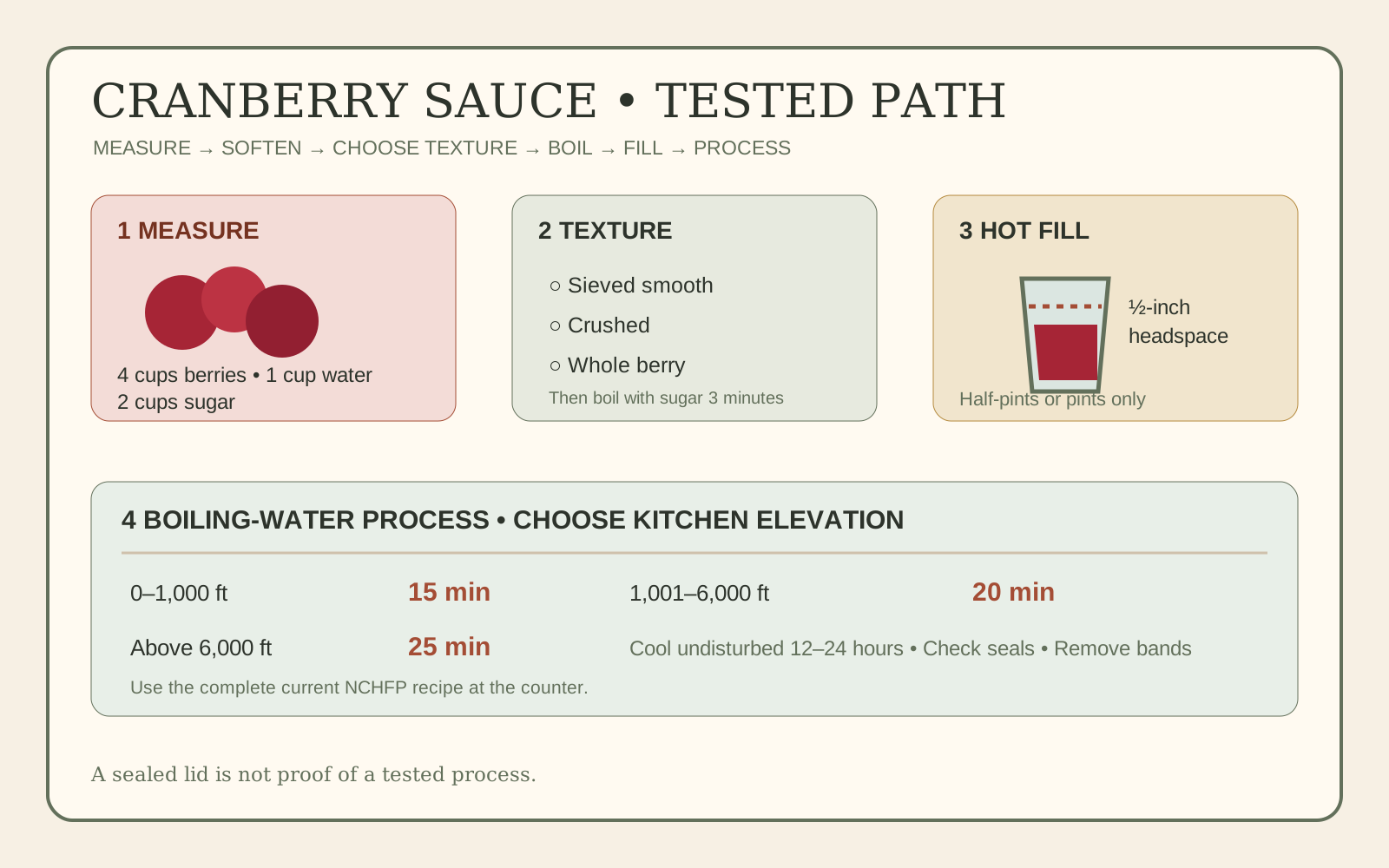
Cranberry sauce looks forgiving because it is acidic, sweet, and cooked before it reaches a jar. That can encourage shortcuts: pour hot sauce into a jar and let it seal, add orange juice by feel, cut the sugar, or use a favorite refrigerator recipe and “water-bath it.” A vacuum seal can form after an untested process. It does not prove the food received a research-tested treatment.
The National Center for Home Food Preservation publishes a specific cranberry sauce formula with three texture options. It names the ingredients, yield, preparation order, jar sizes, headspace, and boiling-water times. This guide explains that tested path and the decisions readers most often need before the holiday rush. Keep the current NCHFP recipe open while you work.
Start with the exact tested formula
The current NCHFP batch uses 4 cups cranberries, 1 cup water, and 2 cups sugar. Its expected yield is about four half-pint jars, and the page says the recipe may be doubled. Measure cups level and keep the proportions together. A 12-ounce grocery bag is commonly about 3 cups according to Penn State Extension, so package count is not a safe substitute for measuring the recipe quantity.
NCHFP's specific allowance to double this batch does not mean any scale is equivalent. Penn State notes that large batches can gel differently. If you double, double every ingredient once and use a pot with ample room for foaming. For more than that, make separate batches. Record the number of batches instead of combining an oversized kettle.
The sugar belongs to this tested sauce formula and helps the expected gel, flavor, and quality. Penn State notes that using less sugar can make a sauce less firm and points readers to formulas designed for lower sugar. Do not reduce the sugar, swap sweeteners, or use a generic fruit-syrup rule in this canned product. If your dietary needs call for another formula, use a current tested lower-sugar product or prepare a refrigerated or frozen sauce from an appropriate recipe.
Fresh and frozen berries can meet at the same starting line
Choose firm, glossy cranberries and discard shriveled, soft, bruised, moldy, or blemished fruit. Remove stems and leaves. Rinse under cold running water and drain. Penn State Extension says frozen cranberries do not have to thaw before use; rinse them and proceed. Frozen fruit is especially useful when a holiday canning day falls after the short fresh-berry season.
Do not use dried cranberries for this sauce. Penn State explains that dried berries do not contain the pectin needed for the expected gel, and their sugar and moisture have already changed. Do not replace part of the cranberries with another fruit unless a separate current tested recipe names that mixture.
Keep the ingredient purpose clear. Cranberries contribute natural acid and pectin. Water lets the fruit soften. Sugar participates in the gel and finished quality. A refrigerator sauce may tolerate improvisation because it is held cold and eaten soon; a shelf-stable jar depends on the published canning process.
Cook the berries until soft before choosing a texture
Wash the cranberries, combine them with the measured water, and cook until the berries are soft. This first cooking step releases pectin and prepares the fruit for one of three NCHFP variations. Do not add the sugar at the beginning or skip directly to packing whole raw berries. The published method softens the fruit first, then adds sugar and boils the finished sauce.
NCHFP permits ½ teaspoon butter after the berries soften if you want to reduce foaming. That amount and timing are part of a specific preparation note. More butter, margarine, oil, or another fat is not an equivalent adjustment and can interfere with jar sealing and product behavior.
Choose the texture before sugar is added. Set out the sieve or masher in advance so softened berries are not cooling while equipment is found. Each published path returns to the same final stage: add the measured sugar, bring the sauce to a boil while stirring to dissolve it, and boil for three minutes.
| Texture | After berries soften | What stays unchanged |
|---|---|---|
| Sieved | Press the fruit through a fine sieve. | Measured sugar, 3-minute boil, hot fill, ½-inch headspace, and altitude time. |
| Crushed | Mash to the desired texture with a potato masher or the back of a cooking spoon. | Same formula and complete canning process. |
| Whole berry | Do not sieve or mash; leave the softened berries whole. | Same formula and complete canning process. |
Do not convert the texture choice into an ingredient change
The three options change the physical treatment of the same cooked berries. They do not authorize citrus, nuts, spices, liquor, dried fruit, onions, peppers, or extra water. Those ingredients can change acidity, density, heat movement, and gel. A “small amount” is still outside this tested formula if the source does not list it.
Cranberry-orange chutney, spicy cranberry salsa, cranberry conserve, and marmalade exist as separate research-tested products. Use their full formulas rather than importing one attractive ingredient into cranberry sauce. A chutney's vinegar, fruit pieces, sugar, jar size, headspace, and time were developed as a system; its ingredients cannot be mixed with this page's shorter ingredient list.
Spices added after opening are an easy quality option. Warm the amount you plan to serve and season that portion. The sealed pantry jars remain within the tested recipe, and different meals can still have different flavors.
Prepare the canner, jars, and work order before the sauce boils
Inspect Mason-type home-canning jars and discard any with cracks, chips, or damaged sealing surfaces. Wash jars and keep them hot until filling. Follow the lid manufacturer's current preparation and tightening directions. The cranberry sauce process is 15 minutes or longer, so follow current NCHFP jar preparation guidance rather than adding an unnecessary separate sterilizing step.
Use a boiling-water canner with a rack and enough depth to maintain the water coverage required by current NCHFP directions. Make sure the canner fits the burner. Mark the kitchen elevation, the selected processing time, and the planned jar size on a batch sheet before the first berry cooks.
Arrange the work in one direction: hot empty jars, hot sauce, headspace tool, clean rim cloth, lids, then canner. This reduces the chance that a jar is filled twice, left unprocessed, or packed in an unlisted size. Keep pets and children out of the work zone and turn pan handles away from the edge.
Fill hot half-pints or pints with ½-inch headspace
After the sugar dissolves and the sauce completes its three-minute boil, ladle the boiling-hot sauce into hot half-pint or pint jars. Leave ½-inch headspace. Remove trapped air bubbles as directed, then measure and adjust the headspace again. Thick sauce can hide pockets, so work around the jar without vigorously stirring air into it.
Wipe the rim with a dampened clean paper towel. Center the lid and apply the screw band according to the lid instructions. Do not use quart jars; the NCHFP cranberry sauce table lists half-pints and pints. A larger jar requires more than a guessed extension of time because heat must reach the coldest part of a different volume.
Do not leave filled jars on the counter to seal. Open-kettle canning—filling hot food and relying on the cooling lid—is not a recommended shelf-stable method. Every jar must receive the complete boiling-water process for its elevation.
Use the cranberry-specific altitude table
Water boils at a lower temperature as elevation rises. The NCHFP table compensates by increasing processing time. Use a reliable elevation for the kitchen where the canner is operating. If you have not confirmed it, pause and use the steps in our canning altitude guide.
| Kitchen elevation | Half-pints or pints |
|---|---|
| 0–1,000 feet | 15 minutes |
| 1,001–3,000 feet | 20 minutes |
| 3,001–6,000 feet | 20 minutes |
| Above 6,000 feet | 25 minutes |
Begin timing when the canner has returned to the required boil. Maintain the boil for the full selected time. If boiling stops, follow the current NCHFP boiling-water canner directions for an interrupted process; do not add an improvised number of minutes.
The 15-minute time at the lowest band is longer than the time used for some jams and jellies. Do not borrow a familiar 5- or 10-minute fruit-spread process. Product consistency, ingredients, jar size, pack style, and research all matter to the published time.
Finish the canner cycle without hurrying the jars
At the end of processing, follow NCHFP's current boiling-water canner directions for turning off heat, handling the lid, waiting, and removing jars. Oregon State's cranberry directions specify removing the canner from heat, removing the lid, waiting five minutes, and then lifting jars. Keep each jar upright and place it on a towel or rack away from cold drafts.
Cool jars undisturbed at room temperature for 12 to 24 hours. Do not retighten bands, press the lid centers, tilt jars to redistribute sauce, or move them to a refrigerator to force the gel. Penn State notes that chilling sauce too quickly may interfere with gelling.
The sauce may continue to set as it cools. Texture is a quality result, not a seal test. A thick sauce in an unsealed jar is not shelf stable, and a softer sauce in a properly processed sealed jar is not automatically unsafe. Evaluate the process and seal separately.
Check every seal and clean sticky jars
After 12 to 24 hours, remove screw bands and test seals using the current NCHFP method. A lid that flexes or appears flat or bulging is not a sound seal. If a jar did not seal and the tested process was followed, NCHFP advises refrigerating and consuming it within one week as a quality option; its reprocessing page explains the limited conditions for safe reprocessing within 24 hours.
Cranberry sauce can leave nearly invisible sugar residue on the jar. Wash and dry sealed jars without disturbing the lids, label them with the product and date, and store them without bands in a cool, dry, dark place. Clean storage makes a later broken seal easier to see. Our seal and storage guide walks through these checks.
Do not taste from a jar with a failed seal, leakage, spurting liquid, mold, rising bubbles, unusual color, or an off odor. Follow current NCHFP disposal guidance for suspect jars. A holiday deadline is not a reason to serve a jar whose process history is uncertain.
Use a batch record to separate safety from preference
Write the recipe source and access date, ingredient quantities, texture choice, jar size, headspace, kitchen elevation, process time, batch yield, and seal count. Also note whether berries were fresh or frozen, whether the optional ½ teaspoon butter was used, and how the sauce set after 24 hours.
At serving time, record the flavor and texture: tartness, sweetness, whole-fruit integrity, spreadability, and whether the jar size matched the meal. Those notes can guide the next allowed choice—whole, crushed, or sieved—without changing the formula. If half a pint is regularly wasted, use tested half-pint jars next time rather than an unlisted container.
A well-kept record also answers the question that a sealed lid cannot: which researched process produced this jar? That matters when jars are given as gifts. Label the product, canning date, and storage instructions, and never imply that a seal alone proves safety.
Questions from the holiday kitchen
Can frozen cranberries be used?
Yes. Penn State Extension says frozen cranberries do not need to be thawed before use. Sort and rinse them, measure the recipe quantity, and follow the current NCHFP process.
Can I reduce the sugar?
Use the tested NCHFP formula—2 cups sugar with 4 cups cranberries and 1 cup water—for this shelf-stable product. Penn State notes that less sugar can weaken the gel and advises using a recipe specifically designed for lower sugar.
Can I add orange zest, juice, spices, or alcohol?
Not to this formula unless a current tested source expressly includes the ingredient. Choose a separate tested cranberry-orange chutney, salsa, conserve, or marmalade and follow its complete process.
Can I use an atmospheric steam canner?
Penn State says properly used atmospheric steam canners can process cranberry sauce, while the NCHFP sauce page provides boiling-water directions. This guide follows the NCHFP boiling-water route. If using steam, follow a current Extension procedure and the equipment instructions in full.
Why did the sauce stay soft?
Batch size, sugar changes, fruit condition, boiling, and rapid chilling can affect gel. Do not recan a soft but otherwise correctly processed sealed jar just to change texture. Chill after opening, and use Penn State's serving-time guidance if you want to thicken an opened sauce.
Sources checked
- National Center for Home Food Preservation: Cranberry Sauce
- Penn State Extension: Preserving Cranberries (updated October 21, 2026)
- Oregon State University Extension: Preserving Cranberries
- NCHFP: Using Boiling Water Canners
- NCHFP: Cooling Jars and Testing Jar Seals
- NCHFP: Storing Home Canned Foods
Reviewed October 29, 2026. Reopen the current tested recipe before processing because source pages and recommendations can change.
Community discussion
Discuss this guide
Share a page-specific result or question about the tested cranberry-sauce process. Replies are reviewed before they appear; untested substitutions, unsafe canning advice, spam, personal information, and unsupported medical claims are rejected.
Loading approved notes…